A Blog About Intellectual Property Litigation and the District of Delaware


Entries for tag: Form Scheduling Order

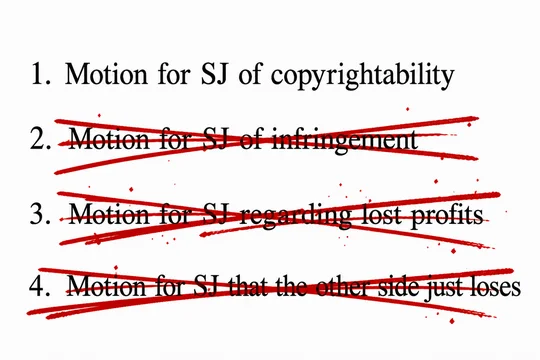
If only we'd ranked the 4th one higher...
If only we'd ranked the 4th one higher... AI-generated, displayed with permission

Chief Judge Connolly updated his form non-patent scheduling order today.

If, like me, you're wondering what changed: worry not! We did a comparison. The main change, other than minor wording and formatting revisions, is that his procedures for ranking summary judgment and Daubert motions now apply to non-patent cases.

This makes sense—we see plenty of rather large and heavily-litigated competitor cases that are not patent cases here in D. Del., including copyright and trade secret cases. These can involve multiple summary judgment motions just like patent actions.

Interestingly, Chief Judge Connolly did not import the page limits for summary judgment motions into his non-patent scheduling order. In …

Scheduling Order

Last month, after her elevation to the bench as a district judge, Judge Hall issued a revised form scheduling order.

I think it's worth paying attention to what changes, even if the changes may not directly apply in your case, because it shows what the judges are focused on and thinking about.

Plus, it usually doesn't hurt to comply with a judge's newest procedures even if they are not required by the (outdated) scheduling order in your case.

So, what's new?

Stating the Meaning of "Plain and Ordinary Meaning"

Judge Hall adopted a set of additional requirements for joint claim construction briefs. Like all of our current judges, she uses Judge Andrews' procedure of a joint claim construction brief. But …

System Update
Clint Patterson, Unsplash

Judge Williams issued a new form scheduling order last week. Updating his previous orders, he primarily added text mirroring Judge Connolly's procedures that require parties to rank summary judgment motions (where if any motion is denied, lower-ranked motions will not be considered):

(d) Ranking of Summary Judgment Motions. Any party that files more than one summary judgment motion shall number each motion to indicate the order in which the party wishes the Court to review its pending motions. The first motion the party wishes the Court to consider shall be designated #1,the second motion shall be designated #2, and so on. The Court will review the party's summary judgment motions in the order designated by …