A Blog About Intellectual Property Litigation and the District of Delaware


Entries for tag: Answer

I like to think we are getting in to spring. That new life is on the verge of breaking free of the currently cold and fetid ground. That Persephone is not held up on some unusually difficult underworld errand. That we may again be renewed.
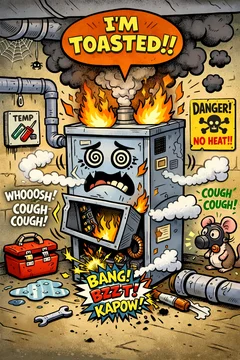
My furnace died during the last snowstorm, which has made me weirdly more poetic and prone to flights of drama
My furnace died during the last snowstorm, which has made me weirdly more poetic and prone to flights of drama AI-Generated, displayed with permission

In that spirit of renewal, I bring you the opinion in Ferrer Int'l S.A. v. Verge Analytics Inc., C.A. No. 24-694-RGA (D. Del. Feb. 24, 2026). That case dealt with a surprisingly novel set of facts.

The plaintiff filed a complaint and the defendant filed counterclaims, which the plaintiff answered. Then, there was an amended complaint, followed by amended counterclaims that were identical to the original counterclaims. The answer to those counterclaims, however, was different from the previous answer, with some allegations that were previously admitted now denied.

The defendant moved to strike these changed responses to the counterclaims, "premised on the theory that Plaintiff could not substantively change its responses to the unchanged allegations of the counterclaims."

In the spirit of the season, Judge Andrews denied the motion, finding that the plaintiff was free to start anew, unfettered by its old responses:

In this case, Plaintiff was required to respond to Defendant’s amended pleading. Plaintiff was not limited to copying its previous response to the counterclaims. It could treat them as new counterclaims.

Id. at 2.

And so let us all bask in the coming light of a new and stronger sun. Free to reconsider old bargains and break new ground.

I am so cold.

I imagine a poor Sirius XM Radio satellite, drifting listlessly through space with nothing to do after 3G and smart phones ate its business model.
I imagine a poor Sirius XM Radio satellite, drifting listlessly through space with nothing to do after 3G and smart phones ate its business model. SpaceX, Unsplash

In answering patent infringement complaints, defendants often do their best to throw in any potentially supportable equitable estoppel / implied license defense they can think of. But in patent actions, these defenses can be hard to prove and are rarely successful. They typically drop off at some point later in the case.

This week we got a great example of what a successful equitable estoppel defense looks like, in an opinion from Judge Bataillon granting summary judgment on that basis.

Basically, it involved lots of incredibly strong facts.

The defendant is Sirius …

Stop
Markus Spiske, Unsplash

We've noted before that parties routinely stipulate to extend the deadline to answer in D. Del. cases. You may have wondered—is there a limit to the number of times the parties can stipulate to extend the answer deadline?

Now we have the answer: Yes, at least for Judge Williams. Here is how he reacted when parties filed their ninth stipulation to extend the answer deadline:

ORAL ORDER: There have been nine (9) Stipulation and Proposed Orders entered in this case granting Defendant an extension of time for it to answer, move, or otherwise respond to the Complaint. See D.I. 20; D.I. 21; D.I. 22; D.I. 23; D.I. 24; D.I. 25; D.I. 26; D.I. 27; D.I. …

RIP, dear stipulated extension
Mr Xerty, Unsplash

Just a heads up, since this has to be one of the more common things that counsel do in cases—this week, Judge Connolly denied a stipulation extending the answer deadline as untimely and lacking a reason:

ORAL ORDER: The parties' stipulation (D.I. 16) being untimely and offering no justification for an extension, it is HEREBY DENIED. Defendant has until June 23, 2022 to answer, move, or otherwise respond to the complaint. ORDERED by Judge Colm F. Connolly on 6/21/22. (ntl) (Entered: 06/21/2022)

Wikeshire IP LLC v. TransCore, LP, C.A. No. 22-445-VAC (D. Del.).

It's not clear from the docket why it was untimely. It looks like the answer deadline was originally 4/28/2022, then it was extended by stip to 5/28, then 6/14. Then, on 6/14 (the due date), the parties filed another stipulation extending the answer deadline to 6/28.

So it looks like the Court rejected a stipulation filed on 6/14 to extend a 6/14 due date. It may be that the parties filed after the 6pm filing deadline. Or, it may be that the Court is taking the view that the stipulation must be filed early enough for the Court to "so order" it prior to the deadline—but I haven't seen that in other cases.

Either way, it's probably safest to list a justification for your stip extending the answer deadline, and to file early going forward! Of course, this can be tricky in high-volume NPE cases, where plaintiff's counsel may be unresponsive until the parties are right up against a deadline.

Pixelated Game Over screen on an oversized PAC-MAN arcade machine
Sigmund, Unsplash

Generally, corporations have to be represented to appear in Federal Court, or they are at risk of default. This is something that comes up surprisingly often, including when corporate defendants try to file their own filings without an attorney (by mailing them to the clerks' office), or when counsel for a corporate defendant seeks to withdraw mid-case.

Judge Fallon issued an opinion today showing the consequences of a corporation failing to retain counsel. Plaintiff brought suit and, requested entry of default after a corporate defendant failed to answer. That corporate defendant then filed an "answer"—which, based on the docket, was not an answer at all, in that it did not respond to plaintiff's claims. Plaintiff then moved …