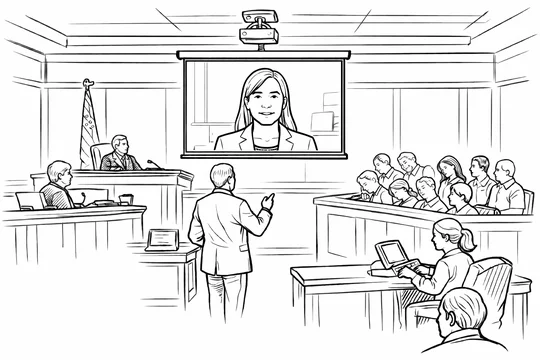
Judge Bryson issued an opinion on Friday looking at a perennial trial question: can one side play the other side's 30(b)(6) testimony in its case-in-chief, even if the witness who gave the deposition testimony is available and testifying at trial?
When we talked about this question back in 2024, Judge Williams had held that, under the circumstances of a different case, a party could only play the other side's 30(b)(6) testimony only for impeachment, not in the first instance. Jazz Pharmaceuticals, Inc. v. Avadel CNS Pharmaceuticals, LLC, C.A. No. 21-691-GBW, D.I. 545 (D. Del. Feb. 20, 2024).
Obviously, there is a big difference between offering deposition testimony in the first instance, and offering it only for impeachment. That was particularly true in the Jazz Pharmaceuticals case, where the oral order seemed to contemplate using the testimony for impeachment only of the specific designee who had testified.
(Given that 30(b)(6) testimony is the testimony of the party, not a specific witness, the opposing party could argue it should be available to impeach any of the party's witnesses.)
Judge Bryson's opinion came to the opposite conclusion than Judge Williams's order. Judge Bryson held that a party can play the opposing party's 30(b)(6) testimony if the witness is available, even if the party playing the testimony is the plaintiff and will present the recorded testimony before the witness ever takes the stand:
Courts have uniformly held that a trial court may restrict a party’s use of the deposition of an opposing party if the deposition is cumulative or irrelevant. . . . But it is a significant step farther for a court to prohibit a party from introducing relevant and non-cumulative evidence in its case because the court believes the evidence, although admissible, should either be used only for impeachment or, if admitted at all, should be admitted only later in the trial, such as in the party’s rebuttal case.
. . .
It is true that the overall presentation of this case would likely be more orderly if the use of [the witness]’s deposition were postponed until after his live testimony in the defense case. Moreover, the defendant understandably would prefer that the jury first be introduced to [the witness] through live testimony in the defense case. After balancing the interests promoted by Rule 32(a)(3) of the Federal Rules of Civil Procedure and Rule 611(a) of the Federal Rules of Evidence, however, I am persuaded that it would be inappropriate to prevent the plaintiff from presenting [the witness]’s deposition testimony in the plaintiff’s case-in-chief. . . . I will therefore permit the plaintiff to offer [the witness]’s deposition in that fashion if it chooses to do so.
Wang v. Injective Labs Inc., C.A. No. 22-943-WCB (D. Del. Feb. 6, 2026).
The Wang opinion is lengthy, for a pre-trial opinion on an evidentiary issue. The Court reviewed and discussed quite a few district and circuit court opinions in coming to this conclusion, although it did not touch upon Judge Williams' opinion or any D. Del. precedent—I imagine the parties did not cite it or any other D. Del. cases.
As to the seeming conflict with Judge Williams' opinion, it's unclear how big it is or whether it really exists. Judge Bryson's opinion involved a plaintiff presenting the defendant's testimony before the designee took the stand. Judge Williams' order involved the opposite: a defendant playing the plaintiff's deposition testimony after the designee had testified. Given that the standard for excluding this testimony under FRE 611(a) is that it is "cumulative or irrelevant," the timing could have been a factor (or not—it's hard to say).
If you enjoyed this post, consider subscribing to receive free e-mail updates about new posts.