In Pierce v. Delaware River and Bay Authority, C.A. No. 24-679-RGA (D. Del.), an employment case, the defendant filed a pretty typical 20-page motion for summary judgment that sought summary judgment on all of plaintiff's claims.
In response, the plaintiff filed a motion for 10 additional pages for its answering summary judgment brief, in order to address all of his claims, including "retaliation under the First Amendment, and Defamation under 42 U.S.C. § 1983 and state law." Id., D.I. 54 at 2. The defendants opposed.
Or, at least, they did in theory. The Court granted the motion before the defendants filed their responsive brief, and the plaintiff received 50% more pages than the defendants did.
(Side note: I would not expect that result in a patent case).
After receiving their free bonus pages, plaintiff's counsel filed a brief in which they stuffed multiple lengthy arguments into footnotes in 10-point font. Just look at this:
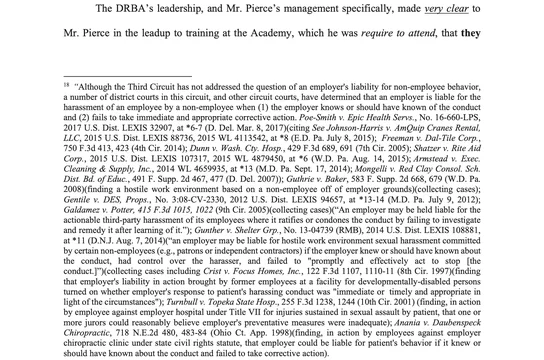
The defendant correctly pointed out in its responsive brief that the local rules require all text, including footnotes, to be in 12 point font. Even worse, despite the plaintiff receiving 10 extra pages, he dropped the claims that he said he needed the pages for.
The Court was not pleased:
Substantial portions of Plaintiff's briefing in both answering briefs are located in massive, single-spaced footnotes written in what appears to be less than or equal to ten-point font. As the DRBA correctly notes, Plaintiff at one point even inserts an entire section of his brief into a footnote. . . .
I had granted Plaintiff's motion for leave to file an additional ten pages in each answering brief, a motion which both Defendants had opposed. (D.I. 54 at 3). I had granted Plaintiff leave to file additional pages in part because Plaintiff attested that in addition to addressing various ADA and ADEA claims, Plaintiff would need to address his claims for "retaliation under the First Amendment and Defamation under 42 U.S.C. § 1983 and state law." . . . Plaintiff dropped these three claims in his answering briefs. It appears that Plaintiff wrote briefs well in excess of what the Local Rules and my order allowing ten additional pages would permit. Plaintiff appears to have impermissibly expanded the space allotted for argument. I note that Defendants adhered to the local rules in their briefing.
Id., D.I. 65 at 1-2. The Court ordered plaintiff's counsel to explain themselves—and to suggest an appropriate sanction:
Plaintiff's counsel [are] ordered to submit a written explanation within five (5) days as to the rationale behind their conduct. Assuming that there is no adequate explanation, Plaintiff's counsel should suggest what they would consider to be an adequate sanction.
Id. at 2.
Lead and Delaware counsel split up the space in their letter responding to the Court, with each providing independent explanations.
Lead counsel said that they dropped the claims after they received the extension, that his normal jurisdiction—EDPA—permits 10-pt footnotes, and that he "wholeheartedly believed that he was filing his brief in compliance with the Court's Rules." D.I. 66. He suggested the embarrassment of having to file the letter was a sufficient sanction.
Delaware counsel gave more detail. He said that he received the papers for the first time just four hours from the deadline, that he could not correct all of the issues in time, and that he simply missed the issue with the font size of the footnotes. I'm sure many, many readers can sympathize:
Plaintiff's local counsel was provided the rough drafts of Plaintiff's two (2) summary judgment answering briefs along with nineteen (19) exhibits at 12:56 p.m. Eastern on Friday, July 18, 2026. . . . Both briefs were due to be filed by 5 p.m. on that date. . . . He had a duty to his client to finalize and file the two (2) briefs and nineteen (19) exhibits in four (4) hours and four (4) minutes to meet the 5:00 p.m. deadline.
However, the briefs and exhibits as provided to local counsel were not in final form and contained at least fourteen (14) formatting issues requiring undersigned counsel to separate two (2) combined documents into six (6) filings (two briefs, two proposed orders, and two certificates of service); correct romanette pagination, correct the tables of contents and authorities, and add e-signatures. . . . So, local counsel worked rapidly to correct the most obvious formatting issues discovered to try to timely file the briefs. . . . However, counsel was unable to catch and correct all of the issues in the time allotted. In so doing, he did not seek to circumvent or intentionally violate the rules. He merely sought to fulfill his duty to his client to try to meet the filing deadlines and avoid failing to respond to the case dispositive motions altogether.
By the time all of these formatting defects were caught and corrected, the 5:00 p.m. deadlines for both briefs had arrived. So, Plaintiff's local counsel turned his attention to filing the work product in its then current format. The briefs were e-filed shortly after the 5 p.m. deadlines. Any and all defects that were caught and fixed do not excuse defects that were not caught. However, they served to consume local counsel's allotted time to try to meet the deadlines, . . . and to distract his attention from the additional errors that he did not correct in rushing to complete and file the briefs by the same-day deadlines of July 18, 2025.
. . . Because failing to meet the dispositive motion deadlines altogether would have been fatal to Plaintiff's case, local counsel prioritized speed over accuracy to attempt to meet the deadlines on behalf of his client.
Id., D.I. 66 at 2-3.
Ouch. I can feel that whole story in my bones. I've received extremely-poorly-formatted briefs just minutes before the deadline and faced a tough choice of filing a brief or letter that technically conforms to the rules but looks awful, or missing the deadline. Delaware counsel here was in an even worse spot, as the briefs at issue did not conform to the rules.
He argued that he shouldn't be sanctioned, because the public admonition is enough:
If the Court determines that this explanation is not adequate, Plaintiff's local counsel suggests that the Court's public filing admonishing him for the lack of compliance and requiring that he submit the instant explanation, and the embarrassment associated with the same, is a sufficient, humbling, and indelible punishment. A hard lesson has been learned by counsel.
Id. at 3.
A hard lesson indeed.
The Court hasn't yet ruled on what an appropriate sanction may be. But even if there is no further sanction at all, this is a great reminder that it's critically important to comply with the length limits and with the rules that impact length (e.g., make sure your brief uses 12-pt font size throughout, that it has 1" margins, and that it meets the page limit). You don't want to be where these attorneys are: arguing to the Court why they shouldn't be sanctioned.
[UPDATE: When I wrote this, the Court had not yet ruled. The Court has since issued an oral order stating that "The Court accepts that counsel acted in good faith in asking for extra pages. The Court accepts that the failure to follow the rules about footnote size was unintentional. The Court will not enter any sanctions against counsel."]
If you enjoyed this post, consider subscribing to receive free e-mail updates about new posts.