In D. Del. the vast majority of discovery motions are brought as discovery disputes. Basically, the parties meet-and-confer, and if they are unable to resolve the dispute, they file a joint letter or jointly call chambers (depending on the judge) to schedule a conference. In the lead up to the conference, they then file short (2- to 4-page) letters about the dispute, and the Court resolves it—possibly before the teleconference.
Do We Even Have a Dispute?
Sometimes, though, the process breaks down when the parties don't agree that they actually have a dispute. That's what happened in Beckman Coulter, Inc. v. Cytek Biosciences, Inc., C.A. No. 24-945-CFC-EGT (D. Del.).
There, according to the parties' letters on the docket, the parties exchanged 18 letters and held four meet-and-confer calls, totaling around 2.5 hours, over the course of three months. D.I. 224 at 1. They were apparently unable to agree that they had a dispute at all, and one party unilaterally filed a discovery dispute letter with the Court. Id. at 2.
The letter raised disputes about the other side's clawback request, and whether the other side must collect and produce certain documents. Id. at 1.
The opposing party then responded with a substantive letter arguing that the core disputes were all waived, because fact discovery closed almost four months before the letter. Id., D.I. 225 at 1. It also disputed whether the parties had met-and-conferred on the full scope of the requested relief and whether that relief was possible. Id. at 1-2. It argued that the parties have additional disputes as well. Id.
At that point, the Court responded and ordered that the parties file a timeline setting forth
ORAL ORDER - IT IS HEREBY ORDERED that, on or before February 26, 2026, Cytek shall file a one-page non-argumentative letter limited to setting forth the timeline of the clawback referenced in its request for a discovery dispute conference (D.I. 224). Cytek's letter shall identify the specific clawed back documents objected to, when those documents were clawed back and when the parties had discussions regarding that clawback. ORDERED by Judge Eleanor G. Tennyson on 2/25/2026. (Entered: 02/25/2026)
Id., D.I. 230.
A Contest of Timelines
Both parties then filed timelines.
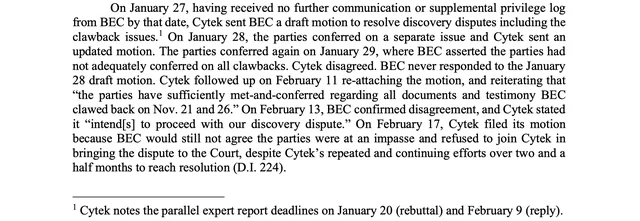
The moving party's "timeline" was a big block of text that is, honestly, hard to follow. It's five paragraphs of prose, but the dates are just sort of jammed together and I can't tell what the reasoning for each paragraph is.
It's a "timeline" in the sense that it says what happened on various dates, but the formatting, the run-on sentences, and the level of detail make it hard to understand. It's basically five paragraphs like this:
The opposing party's timeline was considerably easier to read. They did what looks like a simple table:
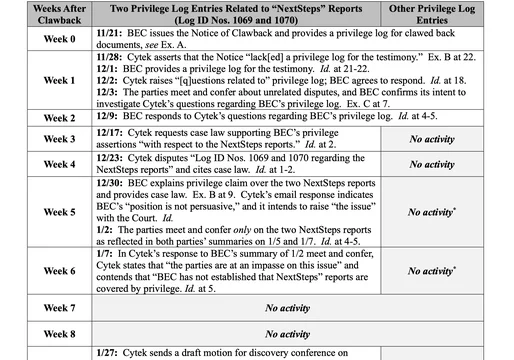
Their timeline looks simple, but they did a few really smart things here:
- They organize it as "weeks after clawback," which makes it super easy to follow and emphasizes their point: that the other side waited too long (they get all the way up to "week 12").
- They include a column for "other privilege log entries" to make clear at a glance which meet-and-confers covered these and which didn't—making their point about the moving party's delay and failure to confer about those other entries.
- The table format is much easier to read generally.
- They include blanks for the weeks with no activity. That's a lot of space they used up within the page, but it really helps convey their point about how long the other side delayed.
- They made the "no activity" spaces visually larger than the rows with activity, making the lack of activity look more significant (compare the visual height of "Week 7" with "Week 2")
- They made all of the delay-related spaces gray so they stand out. It naturally looks like there was a lot of delay here, which is their point.
- They did all of this while keeping the text entirely non-argumentative.
This is an expertly done timeline and a great example for this kind of thing.
The contrast is huge. The moving party's timeline includes just as much or more information, but it's dense text that is really hard to process, and it gives no idea at all what their point is. The responding party presents a super clear timeline that is equally non-argumentative, but that conveys their point (too much delay) through things like structure and formatting. Well done!
The Court Finds That Moving Party Was Not Diligent
It seems like the responding party's timeline may have gotten the point across (that there was a lot of delay here), to the extent the Court considered it. The Court actually went a step further than the responding party had requested—it held that the moving party could not bring the dispute at all because it was not diligent:
ORAL ORDER re 224 - Fact discovery closed four months ago. Expert discovery just closed. Although a document clawback could in theory provide sufficient justification for raising a discovery dispute after the close of fact discovery, that justification is missing here. Beckman clawed back the documents at issue in November 2025, and Cytek did not act with sufficient diligence over the ensuing months to be able to now seek relief from the Court. (D.I. 288). Cytek simply waited too long under the circumstances. Even if the Court were to consider Beckman's timeline (D.I. 229, Ex. 1), it would only confirm this conclusion. And the other issues raised in Cytek's letter are fact-discovery complaints that should have been raised during fact discovery. (See, e.g., D.I. 93 (seeking documents from Yong Qin Chen in June 2025)). THEREFORE, IT IS HEREBY ORDERED that Cytek's motion for a discovery dispute conference is DENIED. ORDERED by Judge Eleanor G. Tennyson on 2/27/2026. (cdd) (Entered: 02/27/2026)
D.I. 230.
It's not clear whether the Court considered the responsive timeline here (it had only asked the moving party to provide a timeline). But either way, it certainly doesn't look like it hurt anything.
If you enjoyed this post, consider subscribing to receive free e-mail updates about new posts.