Hearsay can really trip attorneys up. The many hearsay exceptions may or may not apply to particular testimony, and those exceptions are spread across multiple rules that themselves may or may not apply. And there can be multiple layers of hearsay—with exceptions applying to some layers but not others.
Last week, in Agilent Technologies, Inc. v. Axion Biosystems, Inc., C.A. No. 23-198-CJB (D. Del.), the Court addressed double hearsay in the summary judgment context.
Agilent claimed false advertising by Axion. Axion moved for summary judgment of no false advertising. As part of ruling on that motion under the circumstances of the case, the Court looked at whether "actual customer deception" had occurred.
The Court noted that actual deception must be proven by evidence of how consumers actually reacted, not how they could have reacted—which is typically shown by survey evidence:
As an initial matter, the Court notes that actual deception cannot be proven “by arguing how consumers could react; it must [be proven by] show[ing] how consumers actually do react.” . . . In that vein, the relevant inquiry requires the plaintiff to “adduce evidence that ‘the public was actually misled or confused’” by the allegedly false or misleading statements at issue. . . . Courts have typically come to expect a persuasive consumer survey or other customer testimony in order to sufficiently establish that fact, . . . though such a survey/testimony is not absolutely required if other evidence of actual customer deception exists . . . .
Agilent Technologies, Inc. v. Axion Biosystems, Inc., C.A. No. 23-198-CJB (D. Del. Mar. 12, 2026).
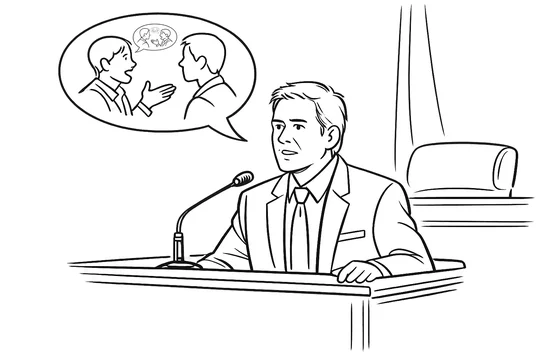
Here, for whatever reason, the party did not offer a survey expert. Instead, it primarily relied on testimony from one of its own employees. That employee heard from another employee that a customer had said something to her that indicated she had been misled:
Agilent cites to certain testimony of its own corporate representative, Dr. Li Leyna Zhao, regarding the purported experience of a prospective customer, Dr. Or-Yam Revach. (Id.) Dr. Zhao stated that she had heard another of her team members, Ryan Raver, say that during a 2024 trade show, Dr. Revach approached him at Agilent’s booth and asked him about Agilent’s products’ ability to accurately measure tumor characteristics in a 3D spheroid. . . . Mr. Raver then informed Dr. Revach that Agilent’s products did not have that capability. . . . In response, according to Mr. Raver, Dr. Revach said something along the lines of, “But Axion has that capability. I will do a demo.” (Id. at 280)
Id. at 8.
Whenever someone says "the client told me that their employee says that a customer said that . . .", hearsay alarm bells should start going off.
Axion did not dispute that the testimony was double hearsay, and the Court found that it was:
[T]his testimony from Dr. Zhao is double hearsay. . . . It is Dr. Zhao’s rendering of one set of out-of-court statements (Mr. Raver’s statements) about another set of out-of-court statements (Dr. Revach’s statements)—all in an effort to try prove the truth of the matter asserted (i.e., that a customer was actually deceived by one or more of the [relevant statements]).
Id. at 8-9.
Since Axion had not disputed the double hearsay or explained how it would be admissible at trial, it couldn't rely on it to defeat summary judgment:
Hearsay statements such as this can only be considered on a motion for summary judgment if they are capable of being admissible at trial—and when a movant challenges the consideration of such a statement at the summary judgment stage, the non-movant must explain to the court “the admissible form that is anticipated.” . . . But here, even though Axion argued in its opening brief (as well as in its reply brief) that Dr. Zhao’s testimony set out above would be inadmissible double hearsay, . . . Agilent made no comment in its answering brief about the admissibility of this evidence, nor of Dr. Revach’s availability to testify at trial . . . . With the nonmoving party having done nothing to explain why the testimony at issue would be admissible at trial, then, the Court cannot consider this hearsay evidence at the summary judgment stage.
Id. at 9.
The Court found the remainder of that witness's testimony unhelpful (it related to the witness's recollection of "many cases" of unidentified customers making similar statements, but she could not recall the specifics), and rejected a once-sentence attempt to rely on statements by Axion's customers that were based on their own direct experiences with the products.
With no evidence of actual confusion, and in light of a further finding that the plaintiff had failed to show a likelihood of injury, the Court granted summary judgment of no false advertising.
If you enjoyed this post, consider subscribing to receive free e-mail updates about new posts.