It's funny—for all the massive amounts of time spent litigating willfulness in patent cases, and the big evidentiary impact it can have, we don't get opinions addressing whether the Court will actually enhance damages all that often.
Yesterday, Judge Andrews issued a post-trial opinion addressing enhancement of damages after a willfulness finding. He applied the well-known Read factors to determine whether to enhance damages, noting that they are still persuasive even though they are no longer required after the Supreme Court's more recent Haloopinion.
Here's how the factors panned out, including whether they weighed in favor of or against enhancement of damages
I'll be honest, I'm busy today so its gonna be a short one.
Let's get this over with -- first a picture:
I cannot imagine how this fit into the post it was intended forAI-Generated, displayed with permission
Second, and last, the following amusing and instructive footnote from Judge Andrews' opinion on post-trial briefing in the long running case of Acceleration Bar LLC v. Amazon Web Servs., Inc., C.A. No. 22-904-RGA (D. Del. Mar. 26, 2026):
Defendant's Opening Brief of twenty-five pages (D.I. 332) raises at least seventeen arguments (D.I. 360). When I noticed a general absence of any attempt to explain how Defendant had preserved most of these arguments, I directed Defendant to submit a …
For the second time in two weeks, Chief Judge Connolly has un-referred a case from a magistrate judge after the parties filed their fifth discovery dispute.
Last time, he scheduled an in-person hearing (rather than the more typical remote hearing) and imposed costs and fees for the losing party. This time, he went further, and threatened a possible trial time penalty if either party takes an unreasonable position.
In Beckman Coulter, Inc. v. Cytek Biosciences, Inc., C.A. No. 24-945-CFC (D. Del.), Chief Judge Connolly had referred all disputes to Magistrate Judge Tennyson just over a year ago. Since then, the parties have brought five discovery disputes, spread out pretty evenly over time:
Although it's included on every scheduling order I've ever seen, the import of the close of fact discovery is not always obvious. Can you bring discovery disputes after? Do you need to update discovery responses after? What even is a fact?
Judge Andrews had an order yesterday in Exelixis, Inc. v. Sun Pharm. Ind. Ltd., C.A. No. 24-1208-RGA, D.I. 188 (D. Del. Mar. 20, 2026), that sheds a bit of light on what you can't do near the close of fact discovery.
The defendant had filed a motion for international judicial assistance (Hagueling, I call it) last month, a couple weeks before the close of fact discovery. The Plaintiff opposed on the …
I don't think we ever did a post on this, but back in 2023, Federal Rule of Evidence 702 was amended to clarify that the burden of showing admissibility of an expert witness's testimony falls on the offering party (addition highlighted below):
A witness who is qualified as an expert by knowledge, skill, experience, training, or education may testify in the form of an opinion or otherwise if the proponent demonstrates to the court that it is more likely than not that:
(a) the expert’s scientific, technical, or other specialized knowledge will help . . .
FRE 702 (2025).
This is consistent with a long-standing Third Circuit holding in In re Paoli R.R. Yard …
Today's case gives us an example of a filing that failed to clear that bar in a rather interesting way.
AI-Generated, displayed with permission
The plaintiff in Tir Techs. Ltd. v. Comcast Cable Comms., LLC, C.A. No. 25-885-JCG, D.I. 48 (D. Del. Mar. 11, 2026), attached actual claim charts to their complaint. This is normally a positive for surviving a 12(b)(6).
The defendants, however, moved to dismiss because the claim charts actually charted infringement by third party Amazon Web Services. The charts and and complaint would then "include frequent variations of the following assertion that '[a] person of ordinary skill in the art would understand that the Defendants would use similar functionality with other CDNs, including the CDN provided by Comcast Technology Solutions.'" Id. at 9 (quoting claim charts). In addition, the complaint alleged that much of the information necessary to chart Comcast's product was uniquely within Comcast's control (a common argument from the Raindance line of cases).
Judge Choe Groves, found this insufficient and granted the motion to dismiss:
Plaintiff’s claim charts may explain how Amazon’s products infringe the Asserted Patents, but Plaintiff does not explain separately how the accused Comcast CDN infringes the Asserted Patents. Plaintiff’s repeated assertions regarding the knowledge of a hypothetical person of ordinary skill in the art are not factual allegations describing how Amazon’s products function similarly to the accused products, but are rather the type of “mere conclusory statements” that are insufficient to state a claim of infringement.
Hearsay can really trip attorneys up. The many hearsay exceptions may or may not apply to particular testimony, and those exceptions are spread across multiple rules that themselves may or may not apply. And there can be multiple layers of hearsay—with exceptions applying to some layers but not others.
Last week, in Agilent Technologies, Inc. v. Axion Biosystems, Inc., C.A. No. 23-198-CJB (D. Del.), the Court addressed double hearsay in the summary judgment context.
Agilent claimed false advertising by Axion. Axion moved for summary judgment of no false advertising. As part of ruling on that motion under the circumstances of the case, the Court looked at whether "actual customer deception" had occurred.
Many of us have the experience of going home again for a while. Maybe you just got back from college and haven't found a decent job yet. Maybe you had a breakup and you needed a place to stay while you sorted out a new place. Maybe your prior home was consumed by a vengeful earth reclaiming what you had stolen.
AI-Generated, displayed with permission
In any case, going home is rarely the result of things going exactly how you'd want them to.
For no reason at all, this leads me to Judge Connolly's recent order in Inari Medical, Inc. f/k/a Inceptus Newco1 Inc. v. Inquis Medical, Inc., C.A. No 24-1023-CFC (D. Del. Mar. 12, 2026) (Oral Order). Judge Connolly had referred the case to Magistrate Judge Tennyson early last year when the parties raised a protective order dispute. Since then, the parties had filed five motions for discovery dispute teleconferences. Upon the filing of the fifth, rather than receiving the usual order scheduling a teleconference, Judge Connolly issued the oral order below:
The Court's January 21, 2025 oral order referring the case to Magistrate Judge Eleanor G. Tennyson for all matters relating to discovery and the protective order is WITHDRAWN. The joint motion for a teleconference to resolve discovery disputes (D.I. 289 ) is GRANTED IN PART and DENIED IN PART. The Court will hear oral argument in person in Courtroom 4B on April 9, 2026 at 9:00 a.m. on the matters outlined in the joint motion. The parties should expect that going forward in this action the party that loses a discovery or protective order dispute will pay for the costs and fees the winning party incurred in litigating that dispute. As both parties have said they are available on April 9, see D.I. 289 at 4, the Court will not agree to move the April 9 argument, though obviously the Court does not oppose canceling the argument if the parties reach an agreement that resolves the disputes in question. The movant for any particular issue must file no later than March 20, 2026 a letter in support of its motion and a proposed order that specifies the exact relief being sought. The respondent shall file no later than April 1, 2026 a letter in response. The letters must be in 14-point font and shall not exceed 1,250 words.
Id.
It's pretty rare to see the Court discuss fees in the context of a discovery dispute, and the move to an in-person conference is also uncommon (although less so). It'll be interesting to see if we get more of these orders for cases that cross the 5-dispute Rubicon.
Parties in patent cases involving software typically agree to protective orders or stipulated agreements setting out the terms for review and use of source code.
These days, the basic outline of these procedures are usually that the party with the source code offers that code for an inspection at their attorneys' offices. The inspection takes place on a laptop with software for reviewing the code, and the reviewers are prohibited from taking the code directly off of that machine.
Instead, parties are usually limited to requesting paper printouts of limited sections of the code. This may seem odd, but it protects source code from leaking in the event of a data breach at a law firm …
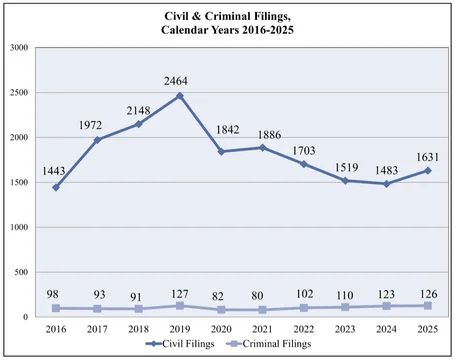
Yesterday, the Court posted its 2026 Annual Report. There are a few easy highlights here.
Civil case filings in 2025 went up by 10%:
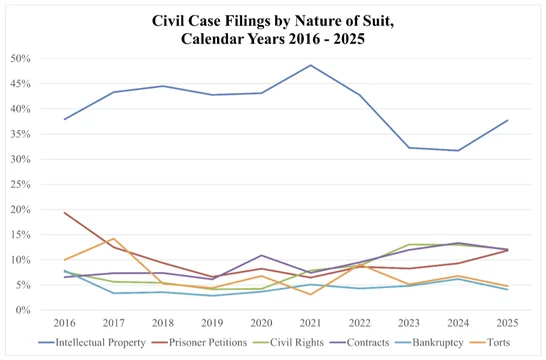
That increase seems to stem from more IP cases and more prisoner petitions:
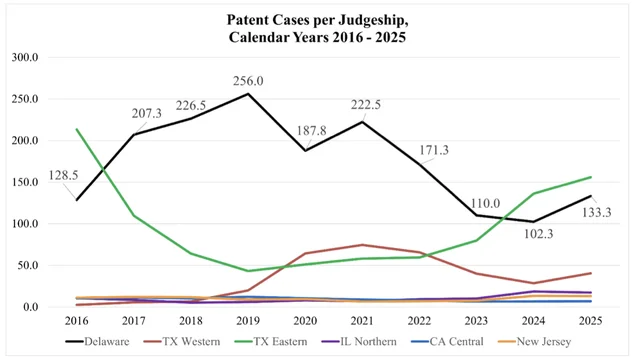
Delaware continues to have one of the highest counts of patent cases per active judgeship:
District Court
In the above chart, Delaware almost takes the lead, but EDTX has more overall patent cases. Of course, in recent years, NPE cases have trended towards TX—if there were a chart of competitor cases, which are much more work, I expect Delaware would easily take the lead.
This blog is for general informational purposes. It is not an offer to perform legal services, and should not be considered a substitute for legal advice. Nothing in this blog should be construed as forming an attorney-client relationship. If you have legal questions, please consult counsel in your jurisdiction.