[Update: As of Feb. 4, 2026, the plaintiff's attorney filed a pro hac motion, and the Court dismissed the case without issue.]
On Friday, in Secure Matrix LLC v. Dress Barn Omni, Inc., C.A. No. 25-1530-CFC (D. Del.), Chief Judge Connolly ordered that the Court will not be considering a stipulated dismissal with prejudice of a patent action until the plaintiff files, and the Court rules on, a pro hac motion for the plaintiff's attorney:
ORAL ORDER: The Court is not willing to entertain the parties' proposed stipulation before [plaintiff's attorney]'s "forthcoming" pro hac vice motion is filed and ruled upon. Ordered by Judge Colm F. Connolly on 1/30/2026. (mws) (Entered: 01/30/2026)
Secure Matrix LLC v. Dress Barn Omni, Inc., C.A. No. 25-1530-CFC (D. Del. Jan. 30, 2026).
I have never seen the Court do this before and, as far as I can tell from a quick search, this may be the first time.
So, what sparked this order? The docket looks absolutely ordinary. The plaintiff filed and served a complaint alleging patent infringement, the defendant filed an answer, and the Court issued an order for the parties to proceed with scheduling. Then the parties stipulated to dismiss with prejudice (presumably, after settling).
The complaint was filed by the plaintiff's Delaware counsel, as required by the rules. In the complaint, the co-counsel attorney was listed as follows:
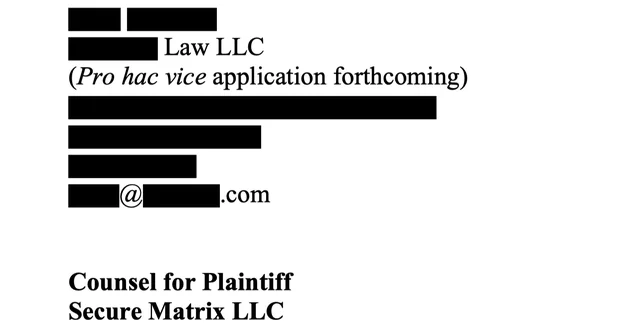
Id., D.I. at 1 at 5 (attorney name & firm redacted).
The attorney was listed the same way, with "Pro hac vice application forthcoming," on a later Rule 7.1 disclosure statement.
Notably, the defendant's attorneys are also listed as "pro hac vice forthcoming" in the defendant's answer:
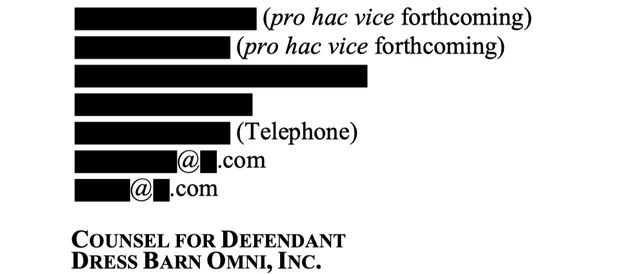
Both of these documents were filed before the stipulation to dismiss with prejudice, but the Court's order only refers to the plaintiff's attorney.
Why? I did a quick web search of the attorney's name, and a Northern District of California sanctions order came up. That order denied the pro hac motion of an attorney with the same name, and referred him for investigation. Cedar Lane Techs., Inc. v. Blackmagic Design Inc., C.A. No. 20-1302-VC (N.D. Cal. Nov. 11, 2020). According to the order, he was involved in the serial filing of patent lawsuits stating that a pro hac vice motion was "forthcoming," without actually filing one before the lawsuits were dismissed:
[T]he process of investigating the [alleged and unrelated] misconduct revealed potential larger-scale misconduct by [the attorney]. It turns out that although [the attorney] is a serial filer of patent lawsuits in the Northern District of California, he is not admitted to practice in this district. Sometimes he seeks pro hac vice admission in these lawsuits, which is improper for someone who practices regularly here. But often [the attorney] does not even bother to seek pro hac vice admission or pay the required fee. Instead, he settles or otherwise dismisses the suits before his failure to seek admission or pay the fee is detected by the Court. [The attorney] is thus referred to the Northern District’s Standing Committee on Professional Conduct for further investigation into whether he has been systematically violating the local rules or otherwise acting illegally or unethically in connection with his patent law practice in this district.
Id.
Is this the concern that triggered the Court's order? It's impossible to say, but it sure looks consistent, given that it came up in the context of a quick stipulated dismissal of a patent action. Plus, the Court flagged concerns only with plaintiff's counsel, not defendant's (who likewise used the "forthcoming" language).
After all, the District of Delaware has a rule, like the rule applied in the Cedar Lane opinion, that attorneys who are "regularly engaged in business, professional, or other similar activities in Delaware" are not eligible for pro hac admission. LR 83.5(c); see Twin Spans Bus. Park, LLC v. Cincinnati Ins. Co., 2021 U.S. Dist. LEXIS 214789, at *4 (D. Del. Nov. 5, 2021) (finding good cause to revoke pro hac admission of individual who "is regularly employed in Delaware and has a Delaware business address").
Deja Vu?
When writing this post, this all sounded very familiar. It turns out that Nate posted last year about how Chief Judge Connolly had raised concerns with the pro hac of a different plaintiff's attorney who had previously been disciplined for serial filings in another jurisdiction. That attorney had previously been involved in at least one of the Mavexar cases.
Are Your Pro Hac Motions Really "Forthcoming"?
This is not the first time in recent months that the Court has noted a failure to file "forthcoming" pro hac motions.
In Allied World Specialty Ins. Co. v. Ellison, C.A. No. 23-751-GBW, 2025 U.S. Dist. LEXIS 204889, at *1 n.1 (D. Del. Oct. 16, 2025), Judge Williams called out two attorneys for failing to file pro hac vice motions that were referred to as "forthcoming" in the signature block on their motion to dismiss:
The Court notes that neither [the first attorney] nor [the second attorney] filed a motion for pro hac vice admission, in contrast to the representation that such motions were "forthcoming." D.I. 22.
The Court nonetheless granted the motion, and the attorneys never filed pro hac motions.
Are two cases a trend? Probably not. But it certainly wouldn't hurt to make sure that "forthcoming" pro hac motions are actually forthcoming.
If you enjoyed this post, consider subscribing to receive free e-mail updates about new posts.