[Note from Andrew: Please welcome Jen Welsh, former prosecutor in the U.S. Attorney's Office in the District of Delaware! Jen is visiting to write our first-ever guest post, below—thank you, Jen!]
I’m Jen Welsh. I was a prosecutor in the United States Attorney’s Office in Delaware for many years, and now I’m a partner at Freeh Sporkin & Sullivan, a firm that handles investigations, white collar defense, and complex litigation matters.
You’ve probably seen me in the courthouse, kicking you all out of a courtroom so that we could handle a sentencing on a break in the middle of your Markman hearing. When I saw that a District of Delaware civil case was turning into a criminal contempt proceeding, I knew this was my chance to finally go from being a longtime IP/DE reader to a contributor.
We all make mistakes. Even the most brilliant attorney has filed a document and later found errors. If the errors are consequential, the correct way to handle that situation is the same way you should handle any mistake of consequence: accept the blame, apologize, and see to it that you don’t make the same mistake twice.
Recently, a New York attorney who was involved in a case in the District of Delaware, handled his mistake ---- differently. Now he faces the prospect of jail time. We’ll call him FTA Attorney, for reasons that will become clear in a minute.
Our story begins with a May 2025 response to a Motion to Dismiss in a civil matter, Gill v. Everyday Dose, Inc., 1:24-cv-1359 (RGA). The plaintiff was represented by Delaware counsel, as well as a New York attorney. That New York attorney had been assisted in the drafting of the Motion by another New York lawyer – FTA Attorney. But FTA Attorney withdrew his appearance before filing and was out of the case. Or so he thought.
The remaining attorneys responded to the pending Motion to Dismiss. Apparently, New York counsel wrote the document and sent it to Delaware counsel the morning of the day it was due.
Delaware counsel took the time to edit it and addressed some issues with the filing, but did not check every citation, because the citations appeared to be the right format and to accurately state the law. It turned out that FTA Attorney had used AI in an earlier draft of that filing, but neither the New York counsel nor Delaware counsel knew that. And it turned out that the filing contained both hallucinated AI citations and fake quotations from real cases.
As we all know, AI sometimes confidently states blatantly incorrect law, which is bad enough.
(Getting into arguments with AI applications is one of my favorite pastimes. Yes, I know in so doing I’m training my robot replacements. But it’s very satisfying. You don’t even have to apologize when you’re mean.)
But the most insidious part of AI usage in legal research is that even when it gets the law right, it may not be citing cases that really exist. Or it may cite cases that really exist, but the cases don’t say what AI claims they say.
Unsurprisingly, the very thorough Judge Tennyson figured this out in December. She meticulously pointed out, in an order to Show Cause, which citations were flawed or made up. Counsel all responded with their explanations. The Court ordered them to attend a hearing to explain themselves under oath. And this is where things went even more off the rails for FTA Attorney.
FTA Attorney requested repeatedly to be excused from testifying. He relied on the fact that he had limited involvement in the case and that he had warned his New York co-counsel to double check the citations. His presence was not excused. The Court ordered him to appear (and, after several warnings, it also ordered him to stop contacting chambers and the clerk’s office).
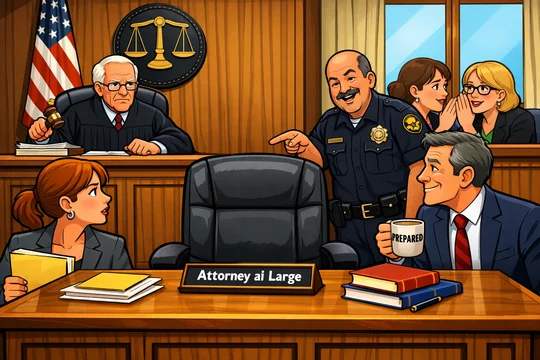
Well, readers… he didn’t appear. Instead, the day before the hearing he filed a notice saying he wouldn’t be there. Although he likely intended that letter as a courtesy, it has the unfortunate effect of proving that he knew of the hearing and intentionally failed to appear. Remember mens rea?
The Court filed a Certification of Contempt against FTA attorney—these are essentially criminal charges. Criminal contempt is a punitive tool meant to address prior contemptuous behavior, in contrast to civil contempt which is intended to bring about a change in future behavior or compensate someone. Taberer v. Armstrong World Indus., Inc., 954 F.2d 888, 896 (3d Cir. 1992).
The case is now being handled by the U.S. Attorney’s Office. FTA Attorney faces up to thirty days in prison and a fine, in addition to whatever professional consequences may follow. He has moved to dismiss the charges, and claims that although he now understands he should have come to the hearing, his behavior wasn’t willful.
FTA Attorney now has to defend a criminal charge because he didn’t come to that hearing. There is a lot of irony in this – he asked to be excused from the hearing because he was busy and had clients to serve, and now he will spend much more time trying to resolve his pending criminal case.
This is a cautionary tale on two fronts. First, failing to comply with court orders can have consequences beyond just your reputation and the outcome of a case. Judges have criminal contempt in their toolbelt, and now we see a judge in the District of Delaware using that tool – for the first time, as far as I’m aware after many years in the U.S. Attorney’s Office.
But the bigger lesson is a reminder that Delaware counsel, even when placed into difficult situations, has a critical role – both in ensuring the accuracy of filings, and in righting the ship when out-of-town counsel starts down the wrong path with the Court.
Gone are the days when counsel can assume that legal citations are correct. They must be checked. That takes time, and communication about the need for an early draft must happen early and often. Consider asking whether or not AI was used in a draft, to be aware of the possibility of hallucinations (although in this instance, even asking may not have been enough—New York counsel was unaware AI was used by FTA Attorney). If you’re pressed for time, consider removing some of the case citations – string cites are often a waste of space anyway. And if there is no time for a good quality check, a last-minute continuance request, however poorly received, is absolutely better than filing a brief that contains false citations.
If you enjoyed this post, consider subscribing to receive free e-mail updates about new posts.


