I admit that, before today, I had no idea how to distinguish between an "artifact noun" and a "natural kind noun." Nor did I know how such knowledge could ever be relevant to my interests. But now I do!
In ruling on claim construction in Belden Inc. v. CommScope, Inc., C.A. No. 22-783-RGA (D. Del.), Judge Andrews ended up delving into grammar to determine whether the term "non-conductively shielding" was indefinite.
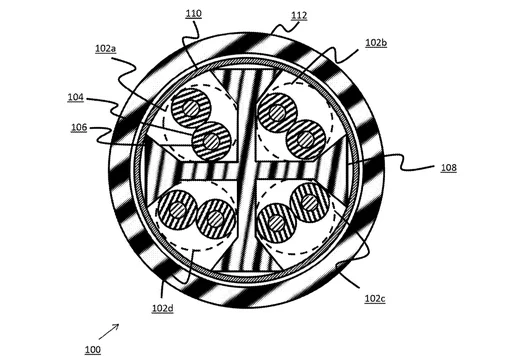
The patent at issue related to high-performance data cables (for example, Cat 6A cables used for 10 GB Ethernet). The patent describes that these cables can have four pairs of wires inside, separated by a filler, and that the filler and pairs of cables are surrounded by a "barrier tape" and a plastic shell.
The claims require that the filler and the barrier tape reduce interference by "non-conductively shielding" two of the pairs of wires in the cable from each other.
The accused infringer argued that "non-conductively shielding" is indefinite because "shielding" necessarily means metallic, and "metal is conductive:"
CommScope argues that this term is indefinite. It notes that the industry standard cited in the specification defines a "shield" as "[a] metallic layer placed around a conductor or a group of conductors." . . . At oral argument, CommScope's counsel noted that the meaning of "shield" as understood in the art would be "a piece of metal that blocks ... radiation." . . . CommScope notes that "metal is conductive—the opposite of 'non-conductive' ... How can you non-conductively shield when a shield is conductive? 'Not A' and 'A' is a contradiction."
Belden Inc. v. CommScope, Inc., C.A. No. 22-783-RGA (D. Del. Apr. 22, 2026).
The Court seemed to accept that "shielding" means metal, and that metal must be conductive. It pointed out that "non-conductively shielding" is nonetheless not indefinite:
The adjective, "non-conductively," modifies the word, "shielding." "Shielding," as CommScope's counsel noted at oral argument, entails using metal to block radiation (or EMI). (D.I. 139 at 54:4-11). It strikes me that the phrase, "non-conductively shielding," would be comprehensible as translated into a phrase such as "shielding without using metal to do the shielding." Indeed, CommScope's counsel conceded at oral argument that such a phrase would in fact be understandable.
Judge Andrews also specifically rejected the idea that "non-conductively shielding" something is somehow an impossibility—and this is where the Court got into the different types of nouns:
I do not accept CommScope's argument that the phrase, "non-conductively shielding," is somehow logically incomprehensible, akin to saying "not-A and A." There are certain words whose referents are necessarily coextensive with the definition of the word.[2]
[2] There is a distinction between some words that may be characterized as "artifact nouns" and others that may be characterized as "natural kind nouns." " Artifact nouns are typically characterized by an intended function, rather than by some ineffable natural essence." Bondi v. Vanderstok, 604 U.S. 458, 470 (2025) (citing S. Grimm & B. Levin, Artifact Nouns: Reference and Countability, in 2 Proceedings of the 47th Annual Meeting of the North East Linguistic Society (NELS 47) 55 (2017)) (quotation marks omitted). In contrast, a "natural kind noun" is one that is "characterized by some often ineffable 'natural essence.'" Grimm & Levin at 55. "Shield" may be characterized as an "artifact noun" and "whole number" as a "natural kind noun." I understand "shielding," a modification of "shield," similarly not to be limited to some "ineffable natural essence."
The Supreme Court case that Judge Andrews cited is from last year, and got into a discussion of "artifact nouns" in the context of whether a federal gun control law reaches "ghost guns," which are sold as a parts kit. That issue turned on whether the kit of parts qualifies as a "weapon"—and the Court got into a discussion of what an "artifact noun" is:
[A] number of considerations persuade us that, even as sold, [a weapon] kit qualifies as a “weapon.”
Consider, first, a feature of ordinary language. The term “weapon” is an artifact noun—a word for a thing created by humans. Artifact nouns are typically “characterized by an intended function,” rather than by “some ineffable ‘natural essence.’” S. Grimm & B. Levin, Artifact Nouns: Reference and Countability, in 2 Proceedings of the 47th Annual Meeting of the North East Linguistic Society (NELS 47) 55 (2017). . . . Reflecting as much, everyday speakers sometimes use artifact nouns to refer to unfinished objects—at least when their intended function is clear. An author might invite your opinion on her latest novel, even if she sends you an unfinished manuscript. A friend might speak of the table he just bought at IKEA, even though hours of assembly remain ahead of him. In both cases, the artifact noun fits because the intended function of the unfinished object is obvious to speaker and listener alike.
Bondi v. Vanderstok, 604 U.S. 458, 470-71, 145 S. Ct. 857, 868 (2025).
Turning back to Judge Andrews' opinion in Belden, he found that the means of "shielding" (metal) could be separated from the function (blocking EMI) in the term non-conductively shielding:
For example, a whole number is a non-negative integer. As such, "non-integer whole number" is a contradiction in terms. It is impossible to logically conceive of what a non-integer whole number might be. But the word, "shielding," describes both a means or quality (namely, that the thing being done is done so by metal) and a function (namely, that the thing being done is blocking EMI/radiation). One might modify away or negate that means or quality by using an adjective, such as "non-conductively," without falling into a logical quagmire; the function itself, "blocking EMI/radiation," would, in that case, be independently left over, and one can logically conceive of a non-metallic thing that blocks EMI/radiation. Thus, the "not-A and A" argument is not applicable here, and I decline to find the phrase, "non-conductively shielding," indefinite.
Lexis says that no case had ever mentioned "artifact nouns" before the Supreme Court did in Bondi—and the three that have done so since then all cite Bondi, including this one. So I'm not sure the distinction between "artifact nouns" and "natural kind nouns" is going to become a common consideration in claim construction. But if it does, now we will be ready!
If you enjoyed this post, consider subscribing to receive free e-mail updates about new posts.